

ResearchWhere do you go when you need a toilet in Fort Kochi?
Something so basic shouldn't turn into an emergency
A late-night search for a public toilet in Fort Kochi, the apps and programmes that already exist, and what I want to learn before building anything.
In short
- Many public toilets in Fort Kochi and Mattancherry are closed, including 13 near Jew Town and the complex at Nehru Park, because of water shortages and sewage disposal problems.
- Toilet-finder apps like KLOO and ToiletSeva exist, but few verified toilets in Fort Kochi show up in them, and both need an app install.
- One idea is a website that needs no install, reached through QR codes on the existing Kochi Ithile wayfinding signs, listing verified toilets with their opening hours.
- This is a volunteer research project through Martian Days: talking to visitors, checking existing toilets, and asking businesses about opening their toilets to the public.
I live in Fort Kochi. I grew up here.
And strangely enough, I've never really had to think about where to find a public toilet.
There's always home, a friend's house, or a relative's place nearby.
Until recently, I was slacklining with a few regulars near Darbar Hall when a tourist approached us, asking where they could find a restroom.
It was around 10 PM, and I could sense the urgency.
The only functioning public toilet we could think of was right next to us, but it had already closed. The petrol pump near the jetty would also be closed.
We couldn't think of another one.
As a last resort, I suggested the Pattalam Mosque, about 500 metres away, although I wasn't even sure whether its facilities would be accessible at that hour.
That incident stayed with me.
Imagine visiting a city you've never been to, walking around its streets, and suddenly needing a toilet. Something so basic shouldn't turn into an emergency.
It got me thinking.
Why is it so difficult to find a functioning public toilet in Fort Kochi? And what can we actually do about it?
The problem isn't new
The obvious answer is that the Corporation should build more public toilets.
And they have.
Over the years, several government-funded initiatives have attempted to improve public sanitation infrastructure.
But building toilets and keeping them functional are two different things.
A May 2026 report by The New Indian Express highlighted several non-operational public toilets across Fort Kochi and Mattancherry.
Some were closed because of water shortages. Others faced difficulties with sewage and wastewater disposal.
The report mentioned 13 closed toilets near Jew Town and a closed toilet complex at Nehru Park.
These aren't necessarily problems that can be solved by putting up a sign or creating an app. Restoring these facilities requires proper infrastructure, maintenance, and continued investment.
But there's another question.
What do people do until these facilities become operational?
The need for a toilet exists today.
And rather than waiting indefinitely for new facilities, I started wondering whether we could make better use of the ones that already exist.
What if more businesses opened their toilets to the public?
There are plenty of hotels, cafes, restaurants, and other establishments around Fort Kochi with functioning toilets.
What if some of them were willing to let people use their facilities, even if they weren't customers?
It could be a voluntary community initiative.
But it's not as straightforward as asking business owners to be kind.
Allowing additional people to use their toilets means more cleaning, water consumption, maintenance, and responsibility.
Some owners might be uncomfortable letting strangers enter their premises. Others might be happy to help someone in an emergency.
I believe there are businesses willing to participate, but that's something I need to test rather than assume.
A good starting point would be to talk to owners, understand their concerns, and find out under what conditions they might agree.
And as it turns out, I'm not the first person to think of this.
There are already people working on this
As I started researching, I came across several initiatives addressing the same problem.
KLOO
KLOO is an initiative by Kerala's Suchitwa Mission, developed in collaboration with Frugal Scientific.
It helps people find public toilets and facilities made available by participating restaurants and other establishments.
I downloaded the app and explored its listings.
It has useful information, and I was glad to discover that some businesses are already participating.
However, I couldn't find many facilities around Fort Kochi. There were a few listings towards Thoppumpady.
This could indicate limited coverage, or perhaps the existing facilities simply haven't been onboarded.
There's another issue.
KLOO is a mobile app.
If someone suddenly needs a toilet, how likely are they to discover KLOO, visit the App Store, download it, and figure out how to use it?
Even if they already knew about it, installing an app during an emergency would probably be their last resort.
To its credit, KLOO doesn't require registration to get started.
But I think there's an opportunity to make this information accessible without requiring an app installation at all.
ToiletSeva
ToiletSeva is another initiative working on toilet discovery.
I tested it too.
Around my location, I mostly found petrol pumps. Some listings are marked as probable, meaning the existence or details of a usable toilet haven't necessarily been confirmed.
The app also has a registration process to access its full functionality.
I found the experience unnecessarily complicated for something that's supposed to help people quickly locate a restroom.
I tend to obsess over user experience, so I'm trying not to make this entirely about app design.
Because the real challenge is bigger than that.
There are also other independent projects, including a web-based initiative called WhereToPee, and Kerala Tourism has an existing toilet-mapping programme.
The solutions exist in different forms. But is the information reaching the people who need it?
That's the part I'm particularly interested in exploring.
Making toilets easier to discover
Suppose we have a reliable list of functioning public toilets and private facilities willing to welcome visitors.
How would someone find that information?
A simple mobile website seems like a reasonable starting point.
Open the website, see nearby toilets, check their availability, and get directions.
No app installation. No registration.
Perhaps even no GPS permission.
For example, we could place location-specific QR codes at selected spots, so scanning one immediately displays available toilets around that location.
The person's location is already known because we know where the QR code was installed.
But that introduces another problem.
How would people find the website or QR code in the first place?
An idea involving Kochi Ithile
A few years ago, Kochi introduced the Kochi Ithile wayfinding project.
These are the large pedestrian maps you might have seen around Fort Kochi and Mattancherry.
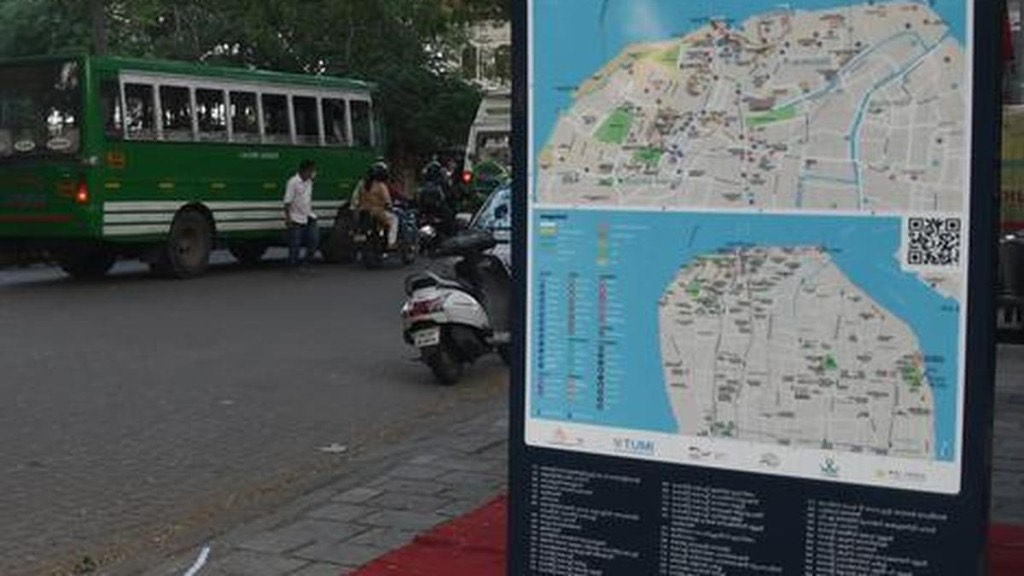
The project originally included 25 signs across the area.
I recently went around looking at some of them.
Several indicate public toilet locations, but I had difficulty verifying some of the facilities they pointed towards. The project's website wasn't accessible when I tried it either.
That made me wonder whether we could build upon this existing infrastructure.
What if these wayfinding signs had a QR code, or perhaps an NFC tag, allowing someone to instantly see nearby, verified toilets?
The website could show what's available, whether it's free, its opening hours, and directions through Google Maps.
No additional app.
And we wouldn't need to build an entirely new network of signs.
Of course, this would require permission and collaboration with the organisations responsible for maintaining them.
But it seems worth exploring.
There are more problems to solve
The more I think about this, the more questions appear.
What if a restaurant agrees to participate, but its staff don't know?
Someone could walk in expecting to use the toilet and be turned away.
A possible solution is to provide participating establishments with a visible sign identifying them as part of the network.
I came across a similar programme in Germany called Die Nette Toilette, where participating businesses display signs indicating that their toilets are available to the public.
Perhaps we could learn from that.
What if the listed toilet is closed or no longer exists?
Someone has to maintain the information.
We could allow visitors to report incorrect listings. Alternatively, volunteers could periodically verify facilities.
But both approaches involve challenges around accuracy, coordination, and time.
And a toilet that was functioning last month might not be functioning today.
What if someone needs a toilet at 10 PM?
This brings me back to the incident that started all of this.
A toilet that's available during the day isn't particularly useful to someone looking for one late at night.
Opening hours and actual accessibility have to be part of the information.
What if someone can't find one of the wayfinding signs?
The existing signs cover only selected locations.
We'd need to explore other ways to reach people: tourist information centres, travel agencies, hotels, transport hubs, Google Maps, or additional signage.
I suspect there's a lot more to discover.
And that's why I don't want to jump straight into developing another application.
What I'm planning next
For now, I'm treating Fort Kochi and Mattancherry as a small research and pilot area.
I want to understand the problem properly before deciding what to build.
I've started reaching out to people and organisations already working on similar initiatives, including Suchitwa Mission, Kerala Tourism, and the Kochi Municipal Corporation.
I'm hoping to learn about their existing programmes, the challenges they've faced, and whether there's an opportunity to collaborate.
Perhaps the answer isn't building another database. Maybe it's bringing existing information together, improving its reliability, and finding better ways to make it accessible.
I also want to get out and do some field research.
The first step would be talking to visitors.
When someone needs a toilet, where do they look first? Google Maps? A nearby restaurant? A local person? A public sign?
I'd like to understand their behaviour rather than assume what they would do.
Then I plan to visit existing toilet locations, document their condition, and see how accurate the available information really is.
Eventually, I'd like to speak with restaurant and cafe owners about participating in a community network, ideally building upon existing initiatives rather than asking them to go through another onboarding process.
With the tourist season approaching in November, December, and January, Fort Kochi seems like a useful place to explore this.
I don't know yet what the final solution will look like.
But I'd like to find out.
An open initiative
I'm exploring this as a volunteer-led community initiative through Martian Days, my small technology company.
I'll be documenting the research, conversations, findings, experiments, and whatever comes out of them.
This is not an announcement of a finished product or a promise to solve the public toilet problem.
It's an invitation to investigate it.
If you've worked on public sanitation, tourism, urban planning, mapping, or similar community projects, I'd love to learn from your experience.
And if you're a resident, visitor, or business owner in Fort Kochi or Mattancherry, your observations could be just as valuable.
Perhaps there's already something useful happening that I haven't discovered yet.
The goal isn't to build another app. It's to make finding a usable toilet a little less difficult.
I'll share more as I learn.